
Choosing a business phone system used to be fairly straightforward. You installed telephone lines, connected office phones, and relied on a physical system to manage incoming and outgoing calls.
Today, businesses have more flexibility. Employees can communicate from different locations, phone numbers can work across multiple devices, and much of the technology behind business calling no longer needs to sit inside an office.
Two solutions often come up when companies modernize their communications: Cloud PBX and SIP trunking.
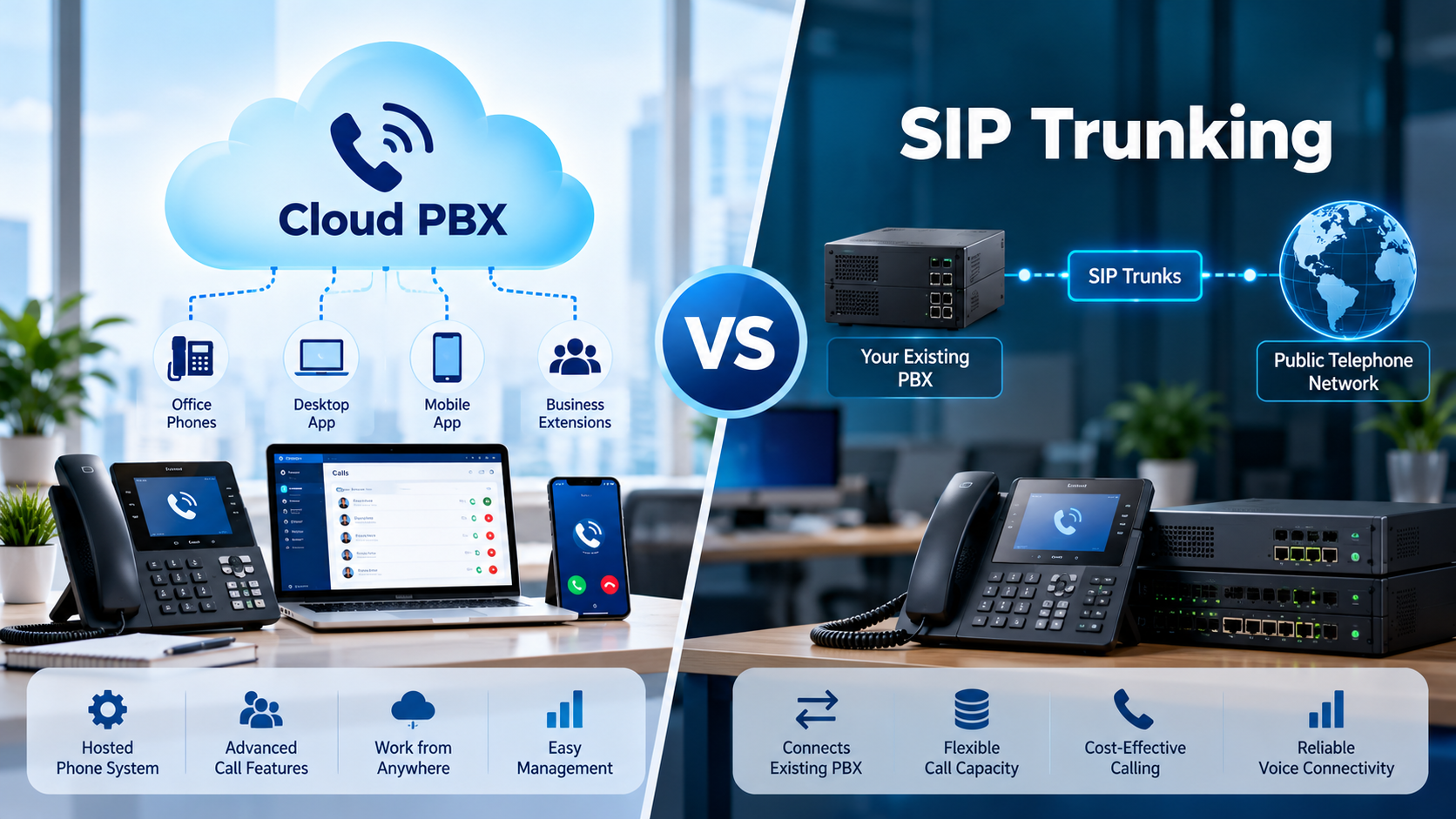
Both use internet-based voice technology, but they solve different problems. One provides a hosted business phone system, while the other connects an existing phone system to external telephone networks.
Understanding cloud PBX vs SIP trunking is important because choosing the wrong approach can lead to unnecessary expenses, technical complications, or features your business doesn’t actually need.
This guide explains how both technologies work, where they differ, what they cost, and how to choose the right solution for your organization.
Cloud PBX vs SIP Trunking: The Quick Answer
Cloud PBX is generally better for businesses that want a complete phone system managed by a service provider. SIP trunking is typically better for businesses that already have a compatible PBX and want to modernize their voice connectivity without replacing the entire system.
The distinction comes down to what your business needs.
If you want phone extensions, call routing, voicemail, and business calling across multiple devices without operating your own PBX infrastructure, Cloud PBX may be a natural fit.
If your organization already has a reliable phone system with established features and workflows, SIP trunking may allow you to keep that investment while replacing traditional telephone connections.
Neither option is automatically superior. The better choice depends on your current equipment, technical resources, calling requirements, and future plans.
What Is Cloud PBX?
Cloud PBX, also known as hosted PBX, is a business telephone system operated through cloud-based infrastructure.
PBX stands for Private Branch Exchange. It manages how calls move between employees, business extensions, departments, and external telephone numbers.
Traditionally, businesses maintained PBX equipment at their own locations. A cloud-based system shifts much of that infrastructure to a service provider.
Employees access the phone system through supported IP desk phones, desktop applications, mobile applications, or browser-based tools.
For example, imagine a company with employees working from an office in Miami, a home office in Texas, and another business location in New York.
With a suitable Cloud PBX setup, those employees can operate within the same business phone environment without needing a separate physical PBX at each location.
Common Cloud PBX Features
Depending on the service provider and subscription, Cloud PBX may offer:
- Business extensions and internal calling
- Auto-attendant and interactive voice response (IVR)
- Call forwarding and custom routing
- Voicemail and voicemail notifications
- Business calling from multiple devices
- Call recording where supported and legally permitted
- Centralized user administration
- Business-hours and holiday routing
- CRM integration
- Usage analytics and reporting
One of the biggest advantages is convenience. Businesses can spend less time maintaining phone-system infrastructure and more time managing their everyday communication needs.
You can explore these capabilities through InstaCall Cloud PBX.
What Is SIP Trunking?
SIP trunking is a method of connecting a compatible business phone system to external telephone networks using an IP connection.
SIP stands for Session Initiation Protocol. It is a communications protocol used to establish, manage, and end sessions such as voice calls.
Instead of relying on conventional telephone circuits, a business can use SIP trunks to carry inbound and outbound calling traffic.
Here’s a practical example.
Suppose a company already owns a PBX that manages extensions, voicemail, call transfers, and internal communication.
The organization is satisfied with its existing system but wants to replace older telephone connections and gain more flexibility with voice capacity.
Rather than purchasing an entirely new phone platform, the company may be able to connect its existing PBX to a SIP trunking provider.
Its current PBX continues managing the phone system, while the SIP trunk provides connectivity to external networks.
Common SIP Trunking Capabilities
Depending on the provider and configuration, SIP trunking may support:
- Inbound and outbound business calling
- Connectivity with existing IP PBX platforms
- Integration with certain legacy PBX systems through gateways
- Flexible concurrent call capacity
- Local and toll-free telephone numbers
- Caller ID presentation
- Number porting for eligible numbers
- Call routing and redundancy
- Usage reporting
- Authentication and encryption options
SIP trunking is particularly useful when a business wants to preserve its existing phone infrastructure while upgrading the connection behind it.
Learn more about InstaCall SIP Trunking.
Cloud PBX vs SIP Trunking: Key Differences at a Glance
Although the two technologies are closely related, they are not interchangeable.
| Feature | Cloud PBX | SIP Trunking |
| Primary purpose | Provides a hosted business phone system | Connects a compatible PBX to external telephone networks |
| PBX ownership | Core PBX platform is typically managed by the provider | Business retains responsibility for its chosen PBX |
| Installation | Usually requires little or no on-site PBX hardware | Requires an existing or separately deployed compatible PBX |
| Management | Provider manages core hosted infrastructure | Business or its IT partner manages the PBX |
| Typical pricing | Often per-user subscription | Often usage-based or concurrent-capacity pricing |
| Phone features | Usually included in the hosted platform | Depend mainly on the connected PBX |
| Remote working | Supported through compatible applications and devices | Depends on the PBX configuration and remote-access capabilities |
| Customization | Controlled by the hosted platform’s available options | Greater control over compatible self-managed PBX configurations |
| Maintenance | Core platform maintenance is largely provider-managed | PBX maintenance remains a business responsibility |
| Scalability | Add users and features within plan limits | Adjust voice capacity subject to PBX, network, and provider limits |
Both solutions require proper network planning, security controls, and suitable external calling arrangements.
1. Infrastructure and Setup Requirements
One of the first differences to consider is where the phone system operates.
Cloud PBX: Less Infrastructure to Manage
With Cloud PBX, the provider operates the central phone-system platform.
Your business generally needs an appropriate internet connection, supported devices, and a configured service account.
You do not need to purchase and maintain a traditional on-site PBX server simply to obtain standard hosted calling features.
This can be attractive for new businesses or organizations that don’t want to manage specialized telephone infrastructure.
However, cloud hosting doesn’t eliminate every technical requirement. Devices, network connectivity, configurations, and local power still matter.
SIP Trunking: Build on an Existing System
SIP trunking works with a compatible PBX, whether the PBX is physically installed at a business location or hosted in an environment controlled by the organization.
An existing IP PBX may connect directly to a SIP provider. Older equipment may require a suitable gateway or software upgrade.
Before proceeding, confirm compatibility, software versions, security settings, supported codecs, and routing requirements.
The practical difference: Cloud PBX provides the phone system as a service. SIP trunking provides a connection for a phone system you already operate or manage.
2. Cost and Long-Term Value
Price is often one of the main reasons businesses compare these technologies.
But simply comparing a monthly Cloud PBX subscription with a SIP trunk rate can be misleading.
The two services may include different components.
Understanding Cloud PBX Costs
Cloud PBX services commonly use subscription pricing.
Businesses may pay based on the number of users, enabled features, service plans, or included calling allowances.
Additional charges can depend on usage, devices, optional features, and other commercial terms.
A hosted model can make recurring expenses easier to plan because much of the core phone-system infrastructure is included in the service.
Understanding SIP Trunking Costs
SIP trunking may use different pricing models, including:
- Per-minute calling rates
- Concurrent call capacity charges
- Monthly telephone number charges
- Usage-based or volume-based arrangements
However, the SIP connection is only part of the total cost.
Businesses also need to account for PBX licensing, infrastructure, maintenance, security, support, and any required upgrades.
A Better Way to Compare Costs
Consider a hypothetical company with 20 phone users but only eight people making external calls simultaneously during its busiest period.
A Cloud PBX proposal may be structured around 20 user subscriptions.
A SIP trunking proposal may be structured around the required concurrent voice capacity and call usage, in addition to the company’s existing PBX expenses.
That doesn’t establish which option costs less.
It shows why user count and simultaneous call requirements are different measurements.
To make a meaningful comparison, estimate the total cost of ownership over a period such as 12 or 36 months.
Include setup expenses, recurring subscriptions, calling usage, support, equipment, maintenance, and expected growth.
The right solution is the one that delivers the capabilities your business needs at an acceptable total cost—not necessarily the option with the lowest advertised rate.
3. Flexibility and Business Growth
Business communication requirements rarely stay the same forever.
A small company might start with five employees and later expand to several departments or locations.
Cloud PBX can simplify this process by allowing administrators to add supported users, extensions, and features through a centralized service.
For businesses opening new locations or supporting remote employees, this convenience can be especially valuable.
SIP trunking offers flexibility in a different way.
If your existing PBX can accommodate additional users and traffic, you may be able to increase external calling capacity without replacing the system.
The limiting factors could include PBX performance, network resources, provider capacity, or contractual arrangements.
So the question isn’t simply, “Which one scales better?”
A more useful question is: What exactly needs to scale—phone users, communication features, or simultaneous external calls?
Your answer can point toward the more appropriate solution.
4. Control, Customization, and Maintenance
Some businesses prefer a managed service. Others want direct control over their communication infrastructure.
A hosted Cloud PBX typically provides an administration portal where authorized users can manage extensions, business hours, call flows, and other available settings.
The provider remains responsible for maintaining the underlying hosted platform.
This reduces the operational burden of running a PBX, although the customer still needs to manage its accounts, permissions, devices, and configurations.
With SIP trunking, the business retains more direct control over its PBX.
That can be useful when an organization has existing technical expertise, specialized routing requirements, or integrations built around a particular system.
Greater control also brings additional responsibilities.
Software updates, configuration errors, system failures, and security settings need ongoing attention.
If your business has limited technical resources, a managed Cloud PBX environment may be easier to operate.
If your organization already maintains a stable PBX and relies on customized workflows, SIP trunking may be a better fit.
5. Call Quality and Reliability
Reliable voice communication is important regardless of the technology you choose.
Neither Cloud PBX nor SIP trunking can guarantee excellent audio quality under every network condition.
Voice performance depends on factors such as internet stability, available bandwidth, packet loss, jitter, routing, equipment, and provider infrastructure.
Reliability With Cloud PBX
Cloud PBX removes the need to maintain the central PBX server at your office.
Depending on the provider and configuration, cloud infrastructure may include redundancy and recovery capabilities.
However, employees still need a working connection to access their hosted phone services.
A local internet outage can interrupt service even when the cloud platform itself is functioning normally.
Reliability With SIP Trunking
SIP trunking reliability depends on the provider connection and the PBX environment.
A business-managed PBX introduces additional elements that the organization must monitor, such as servers, gateways, network devices, and routing configurations.
On the other hand, an appropriately designed SIP environment can support alternate connectivity and failover routes.
Questions Worth Asking Both Providers
Before making a decision, ask:
- What happens if the primary internet connection fails?
- Can incoming calls be redirected to an alternate destination?
- Which service components are covered by the SLA?
- Are backup routes available?
- How are technical incidents handled?
- What monitoring and diagnostic information is accessible?
A reliable phone solution depends on the complete design, not merely whether the PBX is hosted or self-managed.
6. Security and Business Communication Protection
Security is another area where businesses should look beyond general marketing claims.
Cloud PBX and SIP trunking can both support secure communication, but protections depend on how the systems are implemented.
Important considerations include:
- Strong user authentication
- Role-based access controls
- Secure administrative accounts
- SIP authentication and network restrictions
- TLS and SRTP where supported
- Fraud monitoring
- Calling restrictions
- Software updates and security maintenance
- Appropriate record retention policies
A Cloud PBX provider may handle core infrastructure security and software maintenance, while the business remains responsible for user access and device security.
With a self-managed PBX connected through SIP trunks, the business may have greater responsibility for system hardening and monitoring.
For either approach, confirm how your U.S. emergency calling requirements, including applicable 911 and location-information obligations, will be addressed.
Security and emergency calling should be reviewed during the selection process—not treated as optional additions after deployment.
7. Remote and Multi-Location Business Communication
Businesses increasingly need employees to communicate from offices, homes, and temporary work locations.
Cloud PBX is often convenient for these environments.
Supported applications let employees access their business calling capabilities from different devices while administrators manage users centrally.
For example, an employee may use an IP desk phone at the office and a supported application while working remotely.
SIP trunking can also support geographically distributed organizations, but the experience depends on the capabilities of the PBX and its network configuration.
Some businesses operate centralized PBX infrastructure that serves several locations through secure network connections.
Others prefer to let the provider manage most of the phone-system platform.
Both approaches can work. The difference lies in how much infrastructure the business wants to own and maintain.
8. Can Cloud PBX and SIP Trunking Work Together?
Yes, and this is one of the most important details to understand.
The choice isn’t always Cloud PBX or SIP trunking.
Cloud PBX platforms already need a way to connect with external telephone networks, often using SIP-based connectivity behind the scenes.
In a standard hosted service, the provider may include that connectivity as part of the overall package.
Some platforms also support separate SIP trunks, compatible third-party carriers, or hybrid configurations.
For example, a business might retain an existing PBX in one location while using Cloud PBX for additional offices or remote employees.
A hybrid deployment could connect these environments through a planned communication architecture.
However, compatibility should never be assumed.
It depends on the PBX platforms, provider policies, network configuration, supported integrations, and commercial arrangements.
InstaCall supports discussions around SIP Trunking and Cloud PBX configurations, including compatible hybrid approaches.
Which Solution Is Better for Your Business?
The best way to choose is to start with what your organization already has.
Scenario 1: You’re Starting a New Business
You don’t have an existing PBX, and your employees need business telephone numbers, extensions, and reliable calling across several devices.
Consider Cloud PBX.
A hosted phone system can provide the essential features without requiring you to install and manage a dedicated PBX platform.
Scenario 2: You Already Have a Working PBX
Your current phone system meets your needs, but you want to modernize external voice connectivity.
Consider SIP trunking.
A compatible trunk may allow you to preserve your existing PBX while replacing older telephone connections.
Scenario 3: Your Business Operates Across Multiple Locations
You have different communication requirements across offices and want a common approach to user management and business calling.
Evaluate Cloud PBX or a hybrid arrangement.
The right approach depends on how existing equipment, phone numbers, routing, and user requirements fit together.
Scenario 4: Your Business Has Specialized Phone-System Requirements
Your organization relies on existing PBX integrations, particular routing rules, or infrastructure managed by an internal technical team.
Evaluate SIP trunking with your current PBX.
This may preserve your preferred architecture while providing flexible external voice connectivity.
These are practical starting points, not universal rules. A proper recommendation should follow a review of the actual environment.
A Practical Checklist Before Switching
Whether you’re comparing Cloud PBX vs SIP trunking for a new deployment or reviewing an existing setup, these questions can help prevent expensive surprises.
- Do we already own a compatible PBX?
- How many employees need phone access?
- How many external calls occur simultaneously at peak times?
- Which features are essential for everyday operations?
- Do employees need to work from different locations?
- Can our network support the expected voice traffic?
- Are our existing business numbers eligible for porting?
- What happens during an internet or service outage?
- What security and emergency calling arrangements are required?
- What will the solution cost over the next one to three years?
Once these questions are answered, ask your provider to confirm the proposed configuration.
If you are moving existing telephone numbers, establish a porting plan and avoid canceling your current service prematurely. Number transfers, testing, and service cutovers should be coordinated to reduce avoidable disruption.
How InstaCall Supports Both Cloud PBX and SIP Trunking
Every business approaches communication differently.
Some companies want a complete hosted phone system that simplifies day-to-day management.
Others have existing PBX infrastructure and need a dependable way to connect it to U.S. voice networks.
InstaCall provides solutions for both requirements.
InstaCall Cloud PBX
InstaCall Cloud PBX helps businesses manage voice communication through a hosted platform.
It supports features such as business extensions, intelligent call routing, compatible mobile and desktop access, centralized administration, and supported communication integrations.
It’s a useful option for organizations that prefer a managed phone-system environment.
InstaCall SIP Trunking
InstaCall SIP Trunking helps businesses connect compatible PBX systems to external telephone networks.
It supports inbound and outbound calling, flexible concurrent call capacity, business numbers, and technical configurations designed around existing voice infrastructure.
This makes it relevant for organizations that want to retain their current phone system while modernizing connectivity.
Additional Business Communication Options
InstaCall also offers U.S. DID and toll-free numbers for businesses looking to establish or maintain suitable telephone identities.
Available configurations, compatibility, number eligibility, and pricing should be confirmed for each deployment.
If you’re unsure which approach fits your organization, contact InstaCall to discuss your current infrastructure and business requirements.
Frequently Asked Questions
What is the main difference between Cloud PBX and SIP trunking?
Cloud PBX is a complete hosted business phone system, while SIP trunking connects a compatible PBX to external telephone networks. The first focuses on providing the phone platform; the second focuses on voice connectivity.
Is Cloud PBX cheaper than SIP trunking?
Not necessarily. Cloud PBX often uses subscription-based pricing, while SIP trunking may charge by usage or concurrent capacity. Total cost depends on the existing PBX, user count, call usage, maintenance expenses, and required features.
Can I use SIP trunking without a PBX?
SIP trunking generally requires a compatible PBX or another suitable SIP-based application to manage calling functions. If your business needs a complete phone system rather than a standalone network connection, Cloud PBX may be more appropriate.
Is SIP trunking better for large businesses?
SIP trunking can be a strong option for businesses with compatible PBX infrastructure and sufficient technical resources. However, company size alone doesn’t determine the best solution. Larger organizations may also benefit from managed Cloud PBX services.
Can I keep my existing business phone number?
Potentially, yes. Number portability is available for many eligible U.S. telephone numbers. The transfer depends on number eligibility, carrier arrangements, and the provider’s requirements. Confirm the process before changing services.
Does Cloud PBX use VoIP?
Yes. Cloud PBX typically uses Voice over Internet Protocol (VoIP) to carry voice traffic between users and the hosted service. SIP trunking also uses IP-based communication technology, but its role is to provide connectivity for a PBX.
Can Cloud PBX and SIP trunking be used together?
Yes, in compatible environments. Some businesses combine hosted phone services with existing PBX infrastructure or separate SIP connectivity. The exact design depends on provider support, configuration, and technical requirements.
Final Thoughts
The decision between cloud PBX vs SIP trunking isn’t simply about choosing newer technology or finding the lowest monthly price.
It’s about selecting the communication model that makes sense for your business.
Cloud PBX is often the simpler route when you want a complete hosted phone system, centralized administration, and flexibility across devices and locations.
SIP trunking is often the more practical choice when you have a compatible PBX and want to upgrade external voice connectivity while maintaining control over your existing system.
And for some organizations, combining the two may offer a suitable path forward.
Start by reviewing your current infrastructure, calling capacity, operational needs, and long-term costs.
Then choose a solution that supports the way your business actually communicates.
Need help deciding? Explore InstaCall’s business communication solutions or speak with our team about the right setup for your U.S. business.