
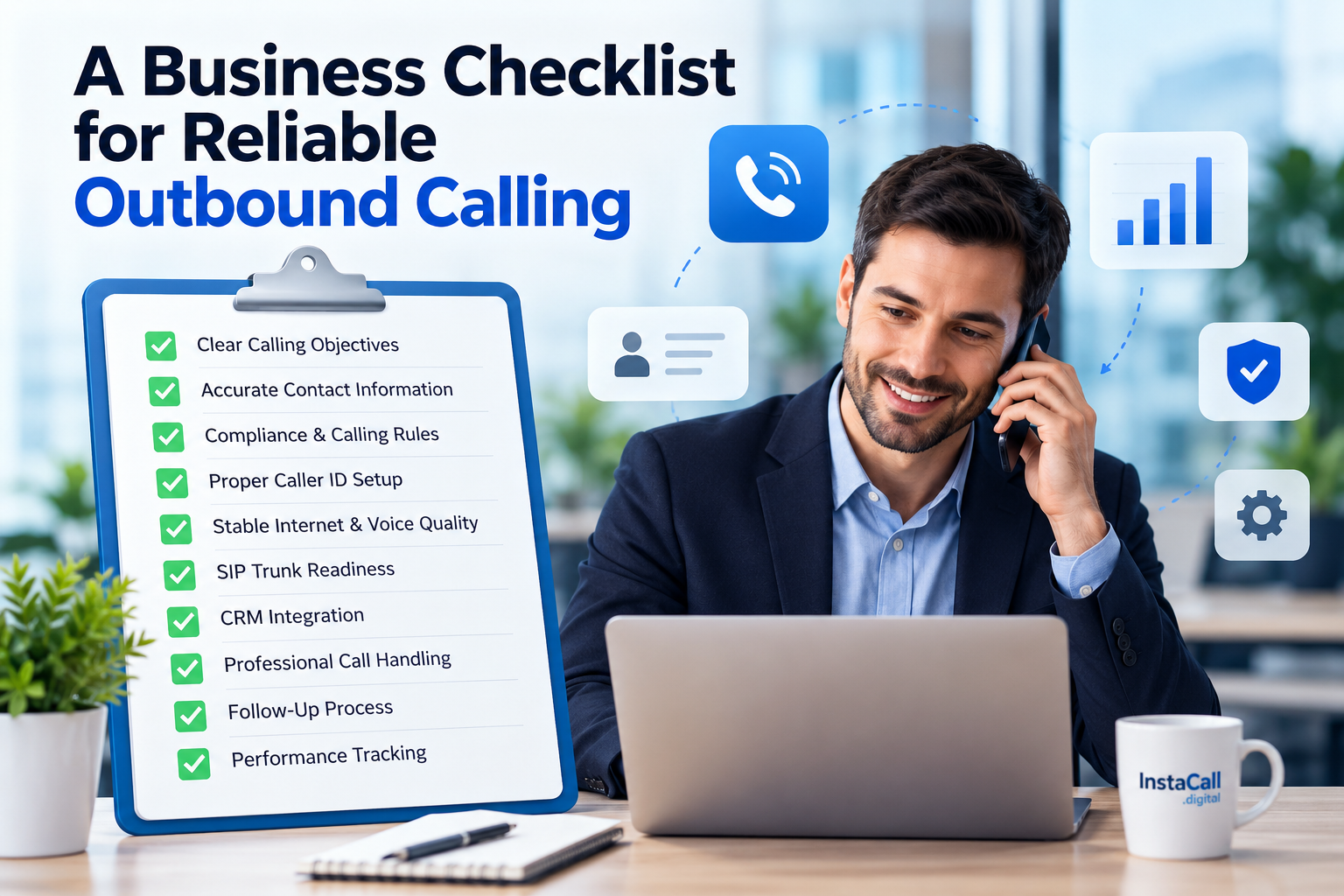
Every business call has a purpose. It might be a follow-up with a potential customer, a conversation with an existing client, an appointment confirmation, or an important service update. Whatever the reason, the call needs to connect clearly, reach the right person, and leave room for a productive conversation.
That sounds straightforward. Yet businesses frequently encounter problems that have little to do with the conversation itself. Calls may fail to connect, audio may break up, customer records may be outdated, or important follow-ups may be missed.
These problems can affect customer relationships, employee productivity, and the overall quality of business communication.
A reliable outbound calling process starts well before someone picks up the phone.
This business outbound calling checklist walks through the practical steps companies can take to prepare their phone systems, maintain accurate contact information, meet applicable regulations, and create a more dependable calling experience.
The Essential Business Outbound Calling Checklist
Before starting your next round of business calls, review these essentials.
Before Making Calls
- Define the purpose of the calls.
- Verify customer contact information.
- Review applicable U.S. calling regulations.
- Confirm appropriate calling hours.
- Check your business caller ID configuration.
- Test internet connectivity and voice quality.
- Verify SIP trunk capacity and call routing.
- Ensure your CRM information is up to date.
During Business Calls
- Clearly identify your business.
- Explain the purpose of the conversation.
- Listen carefully and respond to customer needs.
- Record important information and agreed next steps.
After Each Call
- Update customer records.
- Schedule relevant follow-ups.
- Review technical issues or failed connections.
- Monitor calling performance and reliability.
A checklist is most useful when it becomes part of your regular workflow rather than something you review only when problems arise.
1. Start With a Clear Calling Objective
A productive business call begins with knowing why you’re making it.
Consider two situations. In the first, a company is calling an existing customer to discuss a service renewal. In the second, a sales representative is contacting a potential business client to arrange an introductory meeting.
Both involve outbound communication, but the objectives are different.
Before making calls, identify:
- The intended audience.
- The reason for the conversation.
- The information the customer may need.
- The expected outcome.
- The appropriate next step.
This preparation prevents conversations from becoming unnecessarily complicated.
It also helps employees communicate with confidence while respecting the customer’s time.
Practical takeaway: A clear objective doesn’t mean every call needs to result in a sale. Sometimes, confirming information or answering a customer question is the most valuable outcome.
2. Keep Business Contact Information Accurate
Outdated contact information can create unnecessary communication problems.
A phone number may no longer belong to the intended customer. A business may have moved, changed its main number, or assigned a different person to handle purchasing decisions.
Making repeated calls to incorrect numbers wastes time and can create a poor impression.
Before starting, verify that your contact records contain:
- Correct phone numbers and country codes.
- Current customer or company names.
- Relevant contact details.
- Accurate time-zone information.
- Previous communication notes.
- Applicable consent and contact preferences.
Duplicate records should also be identified and corrected.
For businesses working with multiple customer accounts, a regularly maintained customer database can make daily communication easier and more consistent.
Remember that having a phone number does not automatically establish permission to use it for every type of outbound communication.
3. Understand U.S. Calling Rules Before You Call
Outbound business communication in the United States may be subject to federal and state regulations.
Depending on the purpose and circumstances of the call, relevant requirements may arise under the Telephone Consumer Protection Act (TCPA), the Federal Trade Commission’s Telemarketing Sales Rule (TSR), FCC regulations, and state laws.
Businesses should review several important areas before initiating calls.
Consent and Do Not Call requirements
Check whether the planned calls require prior consent, whether the telephone numbers are subject to applicable Do Not Call restrictions, and whether any recipient has already requested not to receive further calls.
For covered consumer telemarketing activities, businesses generally must use National Do Not Call Registry data obtained no more than 31 days before calling.
Although many genuine business-to-business solicitations are exempt from much of the FTC’s TSR, this is not a blanket exemption from all federal or state calling requirements.
Calling hours
For consumer telemarketing calls covered by the TSR, calls generally cannot be placed before 8:00 a.m. or after 9:00 p.m. in the recipient’s local time without an applicable exception or permission.
Additional state restrictions may apply.
If your business communicates with customers across multiple U.S. time zones, confirm local calling hours before placing calls.
Accurate identification
Businesses should accurately identify themselves and avoid misleading caller information or deceptive representations.
When artificial-voice or prerecorded calls are involved, additional consent and other requirements may apply.
Compliance reminder: Calling rules vary by use case and jurisdiction. Review your specific activities with qualified legal or compliance professionals.
For more information, consult the FTC’s official Telemarketing Sales Rule guidance.
4. Use a Properly Configured Business Caller ID
Caller ID plays an important role in business communication.
When customers receive calls from unfamiliar numbers, they may hesitate to answer. A legitimate, consistently configured business number can help recipients identify and return a call.
However, caller ID reliability involves more than selecting a phone number.
Before initiating outbound calls, check that:
- You are authorized to use the displayed telephone number.
- Your caller ID information is configured accurately.
- The number is active and appropriately routed.
- Customers can return calls when necessary.
- Your voice provider supports applicable caller authentication requirements.
In the United States, STIR/SHAKEN helps participating networks authenticate caller identity information.
It does not, however, guarantee call completion, prevent every fraudulent call, or ensure that calls will never be labeled as spam.
Businesses that need U.S. telephone numbers can explore InstaCall’s local and toll-free DID solutions.
Choosing suitable business numbers is one part of creating a dependable communication setup.
5. Check Your Internet Connection and Voice Quality
Voice quality can make or break an important business conversation.
Imagine discussing a contract renewal with a customer when the audio begins cutting out. You may need to repeat information, reconnect the call, or reschedule the discussion entirely.
Even when both sides are prepared, technical interruptions create unnecessary friction.
For businesses using internet-based voice communication, several network conditions deserve attention.
Bandwidth and network stability
Make sure your internet connection can support the expected number of simultaneous voice conversations alongside other business applications.
Available bandwidth is important, but network stability matters just as much.
Latency, jitter, and packet loss
These three technical factors influence voice quality:
- Latency: The delay between someone speaking and the other person hearing it.
- Jitter: Variations in packet arrival timing that may disrupt smooth audio.
- Packet loss: Missing data packets that can cause distorted or incomplete speech.
Persistent issues in any of these areas can affect conversations.
Equipment and software
Check microphones, headsets, IP phones, and business calling applications.
A simple test call can reveal problems before they affect customers.
If your business depends on outbound voice communication throughout the day, monitor network quality regularly rather than waiting for employees to report repeated issues.
6. Verify SIP Trunking and Call Capacity
For organizations using an IP-based phone system, SIP trunking can provide the connection between their existing communication infrastructure and external telephone networks.
But having SIP connectivity in place doesn’t automatically mean every configuration is ready for business needs.
Review the following before relying on your setup:
- Available concurrent call capacity.
- Correct outbound routing configuration.
- Compatibility with your existing phone system.
- Supported audio codecs.
- Incoming and outgoing call behavior.
- Error handling and recovery arrangements.
- Service provider support and escalation procedures.
For example, if several employees make business calls at the same time, the system should have adequate capacity to support the expected activity.
Insufficient capacity may result in failed connection attempts or other disruptions.
Businesses should also confirm that any planned increase in voice traffic can be accommodated by their current provider and network setup.
InstaCall SIP Trunking offers business voice connectivity for compatible phone systems, helping organizations manage inbound and outbound communication through IP-based infrastructure.
A properly planned voice setup makes routine business calling more predictable.
7. Organize Customer Information With CRM Integration
Reliable calling isn’t just about establishing a connection. It also involves maintaining continuity from one conversation to the next.
Suppose a customer asks for a follow-up next week, requests additional product information, or mentions an unresolved service issue.
If those details aren’t recorded, the next conversation may begin without the context the customer expects.
A customer relationship management system can help businesses organize information such as:
- Previous phone conversations.
- Customer requirements and preferences.
- Sales opportunities.
- Requested callbacks.
- Follow-up tasks.
- Account history.
- Relevant contact restrictions.
Keeping this information in one accessible location can reduce duplicated work and improve coordination between employees.
When communication tools are integrated with a CRM, businesses may also be able to streamline call-related workflows and customer record updates.
InstaCall CRM Integration Services help connect business communication with customer management processes.
The objective is simple: make important information available when it’s needed, without asking customers to repeat everything.
8. Keep Business Conversations Clear and Professional
Technology supports the connection, but the quality of the conversation still matters.
Successful business communication is generally straightforward, respectful, and relevant.
A good opening should identify the business and explain the reason for contacting the recipient.
For example:
“Hi Michael, this is Daniel from [Company Name]. I’m following up about the business communication options we discussed earlier. Is this still a convenient time to speak?”
This approach provides context without overwhelming the recipient.
During the conversation:
- Speak clearly and at a comfortable pace.
- Explain technical information in simple terms.
- Ask questions when clarification is needed.
- Avoid unnecessary interruptions.
- Respect the customer’s response.
- Confirm any agreed next steps.
Remember that the appropriate introduction and disclosures may differ depending on the nature of the call and applicable regulations.
Clear communication helps avoid misunderstandings and makes each interaction more productive.
9. Have a Plan for Unanswered and Interrupted Calls
Not every outbound call will be answered.
Some customers may be unavailable, while others may be busy or unable to talk at that moment.
Technical interruptions can also occur.
Instead of repeatedly attempting to reach someone without a clear process, establish sensible follow-up procedures.
For example, your business might:
- Record that the call was not answered.
- Check whether further contact is appropriate.
- Schedule a follow-up at a suitable time.
- Use an authorized alternative communication channel.
- Document technical failures when a call disconnects unexpectedly.
Avoid excessive repeat calls or attempts that conflict with customer preferences or applicable rules.
If a conversation ends because of a technical problem, review whether the issue originated from local connectivity, the phone system, or the voice network.
This creates useful information for troubleshooting recurring problems.
10. Track Call Reliability and Business Outcomes
Monitoring outbound calling performance can help businesses distinguish between technical problems and communication issues.
A few practical indicators can provide valuable insights.
| Performance Indicator | Why It Matters |
| Call completion rate | Helps assess whether calls are connecting successfully |
| Connection failures | Identifies unsuccessful attempts requiring investigation |
| Average call duration | Provides context about answered conversations |
| Audio quality | Helps reveal voice connectivity problems |
| Follow-up completion | Shows whether agreed next steps are being completed |
| Customer response | Helps evaluate the relevance and effectiveness of communication |
These metrics should be interpreted carefully.
A longer conversation doesn’t necessarily mean a better outcome, and a brief call isn’t automatically unsuccessful.
Likewise, different communication platforms may use different definitions for connection and completion metrics.
Look for patterns over time rather than drawing conclusions from one isolated result.
For example, repeated connection failures may justify reviewing SIP routing, provider performance, or network stability.
Missed follow-ups may indicate a need to improve internal workflow and customer record management.
11. Protect Business Communication Records
Customer communication records often contain sensitive information.
Names, telephone numbers, account details, and business conversations should be managed according to appropriate security and privacy policies.
Before storing or sharing call-related information, consider:
- Who is authorized to access it?
- How is customer information protected?
- Are access permissions reviewed regularly?
- Are call recordings permitted under applicable laws?
- How long must relevant records be retained?
- Are required consent and opt-out records maintained?
Under the FTC’s 2024 TSR amendments, covered businesses are generally required to retain specified telemarketing records for five years. The exact records and exceptions depend on the regulation.
That does not mean every business must record every conversation.
Businesses should establish retention and security procedures based on their actual legal obligations.
12. Review Your Communication Setup Regularly
A checklist shouldn’t be used once and forgotten.
Business communication needs change. Teams grow, customer volumes increase, phone systems evolve, and network requirements become more complex.
Regular reviews help identify small issues before they become larger operational problems.
Consider scheduling periodic checks covering:
- Business phone numbers and routing.
- SIP trunk capacity and configuration.
- Internet and voice performance.
- Customer contact information.
- CRM workflows.
- Relevant compliance procedures.
- Service provider support arrangements.
A reliable outbound calling environment depends on both technology and consistent operational habits.
How InstaCall Helps Businesses Maintain Reliable Voice Communication
Businesses need communication infrastructure that supports everyday operations without unnecessary complexity.
Whether your organization is making customer follow-up calls, coordinating with business partners, or supporting sales conversations, dependable voice connectivity makes a difference.
InstaCall provides U.S.-focused cloud communication and business voice solutions, including:
SIP Trunking — Connect compatible business phone systems with external voice networks and support flexible communication requirements.
DID and Toll-Free Numbers — Establish suitable U.S. business numbers for customer communication and return calls.
Cloud PBX — Manage business phone users, extensions, routing, and communication across supported devices.
CRM Integration — Connect communication activities with customer information and business workflows.
By choosing infrastructure that fits their needs, businesses can create a more organized and dependable communication environment.
To discuss your requirements, contact InstaCall.
Frequently Asked Questions
What is a business outbound calling checklist?
A business outbound calling checklist is a set of practical steps for preparing and managing outbound phone communication. It typically covers accurate contact information, applicable regulations, caller ID, voice connectivity, phone system readiness, customer records, and follow-up procedures.
How can businesses improve outbound call reliability?
Start with stable internet connectivity, properly configured business phone numbers, adequate SIP trunk capacity, and regular voice quality testing. Monitoring connection failures and addressing recurring technical issues can also help.
Why is SIP trunking important for business outbound calls?
SIP trunking enables compatible IP-based business phone systems to connect with external telephone networks. It can support flexible calling capacity and integration with existing communication infrastructure.
What should businesses check before making outbound calls in the U.S.?
Businesses should review applicable calling and consent requirements, contact restrictions, permissible calling hours, customer information, authorized caller ID, and phone system readiness. Requirements vary according to the purpose and circumstances of the call.
Can a Cloud PBX support outbound business communication?
Yes. A Cloud PBX can provide business calling features such as user management, extensions, call routing, and access from supported devices. The available functionality depends on the provider and service configuration.
How often should a business review its outbound calling setup?
The appropriate schedule depends on calling volume and business requirements. Regular technical checks are useful, with additional reviews after major system changes, connectivity problems, or updates to relevant regulations.
Final Thoughts
Reliable outbound calling is not simply about making a connection. It’s about ensuring that every business conversation has the right preparation, technology, and follow-through behind it.
From accurate contact records and properly configured caller ID to stable voice connectivity and organized customer information, small details can make a meaningful difference.
Use this business outbound calling checklist to evaluate your current communication process, identify potential issues, and establish more consistent calling practices.
If you’re looking to strengthen your U.S. business voice infrastructure, explore InstaCall’s communication solutions or get in touch with the team to discuss your requirements.
Editorial note: U.S. calling regulations can change. Businesses should review current federal and state requirements and seek qualified legal guidance for their specific activities.